
Inside the Design
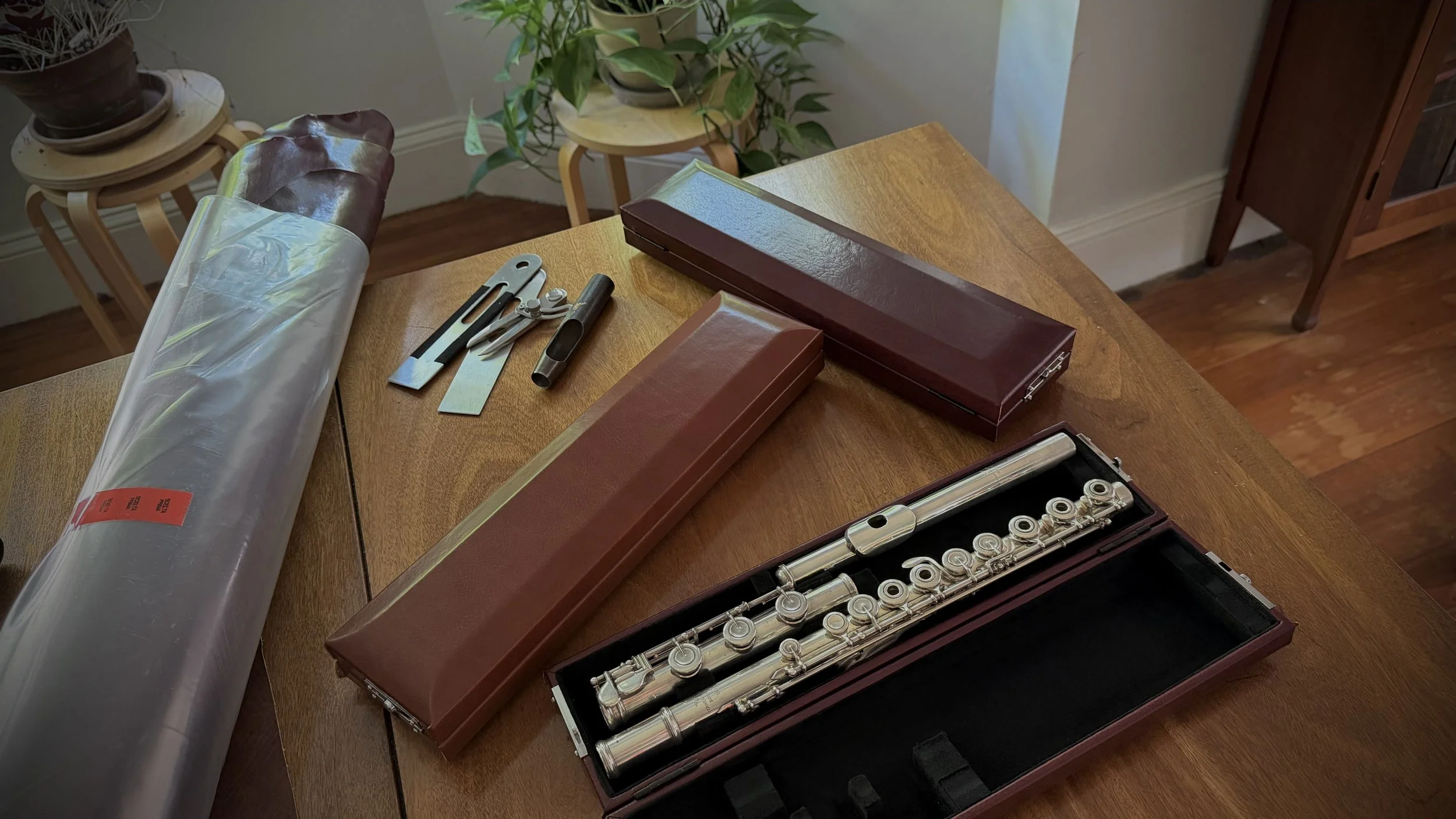
I started designing our flute case about 5 years ago, as an intellectual exercise, while I was working as a Flute Maker. The project accelerated when I received the following request from an international performing artist: “I need a flute case that fits in my shoulder bag”.
I visualized a universal case that could fit any flute without adjustments. This case would be as small and light as possible and strong enough to be virtually uncrushable.
I soon realized that the only material capable of satisfying all those requirements was carbon fiber, an exotic, expensive material of spectacular strength and beauty, but terribly difficult to work with: its processing requires knowledge and proper tooling found only in an industrial setting.
Carbon fibers are incredibly fine and are woven into an almost weightless fabric that is embedded in a resin. This resin can then be cast and formed using complex moulds, built to retain their very precise geometry while heated to hundreds of degrees in a chamber - called “autoclave”- under vacuum.
The carbon fiber we use to make our cases is of a specific kind used in the aerospace industry: it is a carbon fiber cloth, saturated with the optimal proportion of resin and carbon. The parts obtained are extremely thin and light but colossally strong and tough.
When we observe and touch carbon cloth by itself, before it is saturated with resin, we always wonder how such a frail material could be used to make parts which are incredibly strong but so thin.
The special property of carbon fiber is that each strand is not only very hard but also very rigid. The only material able to cut carbon fiber is diamond; carbon otherwise dulls very expensive cutting tools very quickly. Care must also be taken when cutting and trimming the resin matrix, as the dust is toxic when inhaled.
Carbon fiber is breathtakingly beautiful: it scatters light in different ways depending on the position of the light source. For this reason carbon cloth is woven with different weave patterns, to exploit this unique optical characteristic. For my case I used a fine weave to suit the dimensions and shape of the shells. Many people liken the optical effect of carbon fiber composite to the way Chinese lacquers scatter light.
Carbon fiber is also athermic, meaning that it reflects heat without absorbing it. For this reason, when exposed to the sun or left in a hot car, the inside of the case will be about 10C to 20C cooler than a typical case. That is 50F to 100F cooler, without an insulated case cover!
Upon conception, I quickly realized that the only way to make a shorter case was to place the sections differently from the classic French case: in 3 rows rather than 2.
However, just placing the sections in 3 rows makes a shorter case, but also widens it. To make a case that is shorter but not wider, I needed to exploit the shape of the sections and arrange them in a specific grid: the main line section would be in the back facing front. The G# key protrudes to the front, so the only way to save space would be to arrange the remaining sections on the right and on the left of the G# lever.
However, the shape of the remaining sections, the foot joint and the head joint, are very different from each other: the foot joint is shorter, has an end ring at the bottom and levers at the opposite side. The levers protrude only on the top end, so they need to be arranged in an efficient way in order to reduce the total footprint of the case.
The head joint is longer than the foot joint, and one end is sensibly thinner than others.
The only rational solution was placing the head joint’s thin end as close as possible in front of the G# lever and the foot joint in the remaining space on the right, in front of the barrel and oriented with the levers toward the right.
The next step was to find a way to safely block the sections within the case when it is closed.
This step was not the last: I needed to find a way to fit different brands in the case without alterations.
All flutes have significant variations in length: the main section is considerably longer in certain brands and the head joints differ in length as well. Another variable is the thickness of the crown, which can be massive in certain brands.
Here was the most challenging part of the design: traditional cases hold the sections by the sides, so shorter flutes need spacers at the ends to hold them steady when the case is closed. The solution was to hold the sections steady simply by the clamping action of the shells when closed. The mainline is held steady by the shells clamping the tenon and the tube section right below the barrel. The head joint is held steady in an analogous way, leaving free space at the top end to fit even the thickest crowns.
Holding the foot joint was the most challenging part: while the length of the foot joint is nearly identical in all brands, the spacing of the keys is not. My solution was to use the clamping action of the shells at the end of the foot joint at the left, in such a way that two protrusions from the top shell would always fall between the keys, whose spacing varies.
In summary, a thinner shell paired to a more space- effective interior results in a flute case, the most compact ever designed, which fits in a shoulder bag.